
Can anyone have a mezuzah? Or does it belong only to the Jews?
A Cornerstone of the Religion
The mezuzah is a sacred object that plays a central role in Jewish tradition.
It is used in a ritualistic way.
It contains our most important prayer, the Shema.
Affixed to the doorpost, it defines the home as a Jewish home.
It is not a secular object. So, it is not surprising that many Jews believe the mezuzah should not be used by Gentiles.
How could outsiders be allowed to use something so sacred and central to us?
The Scroll
Let’s step back a bit and look at what a mezuzah is.
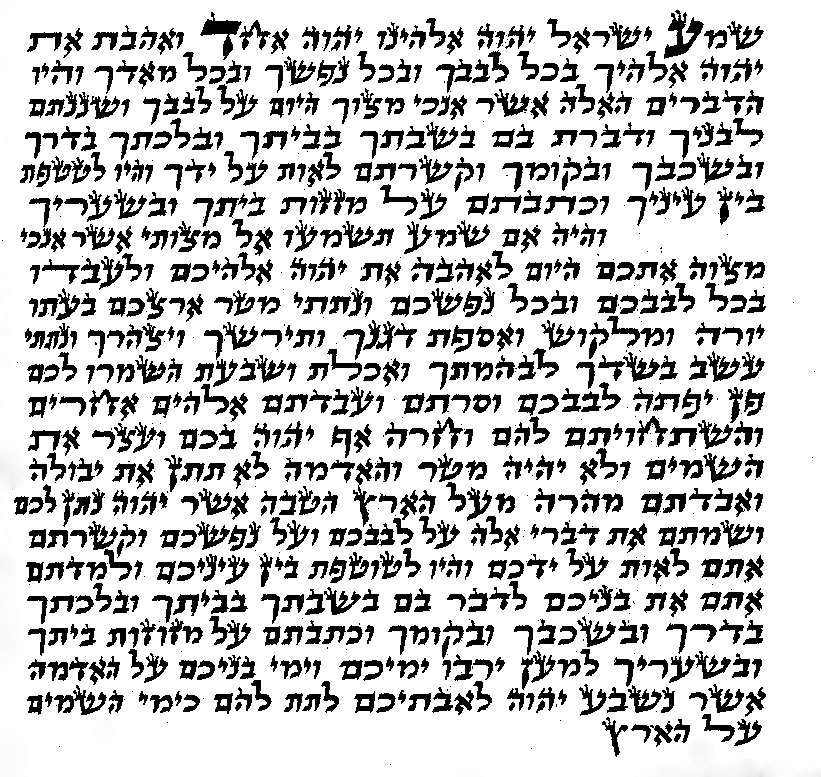
In common usage, the word mezuzah refers to its two elements: the scroll inside and the case that holds it.
More accurately, however, when we say mezuzah, we are talking about the scroll. This is the sacred part, the part that contains the Shema, and passages from the Torah.
In order for a mezuzah to be kosher, it must be written by hand by a highly trained sofer or scribe on specially prepared parchment with specific ink, and cannot contain a single mistake.
However, many people settle for a scanned or photocopied scroll, to avoid the expense of a handwritten one. Some even choose to replace it with a prayer or other text of their own choosing.
These choices represent the wide range of belief among modern Jews.
Two Non-Jewish Friends
-Kaela’s Mezuzah
I worried a lot about cultural appropriation, but I realized that it’s what’s inside that’s important. I replaced the included scroll with a prayer/blessing of my own.
Kaela sent me this message after purchasing one of my mezuzah cases.
By removing the scroll, the mezuzah becomes only the case. It is no longer a sacred Jewish object.
But the more important thing for me, is that Kaela thought about appropriation.
I am happy that a Jewish marker hangs on her doorpost and happy that she can have it as a reminder of the holiness contained in her personal prayer/blessing.
-Marion’s Mezuzah
After talking with friends who practice Judaism about whether hanging a mezuzah would be appropriate, we decided that this was a gesture of connection we wanted to make part of our home, though that we should replace the scroll with something of similar but secular meaning. We made sure we understood how to respectfully do this and selected a beloved poem about finding home and your place in the world, that I hand wrote on special paper to tuck inside our mezuzah. It’s become a nice part of my routine coming home, and I hope that it is a gesture of solidarity with Jewish communities and others who seek belonging. And of course we wanted to support you, as an artist and our friend!
Marion bought one of my mezuzah cases and asked me if it was ok to replace the scroll with a poem she loves by Mary Oliver. Like Kaela, Marion was grappling with the issue of cultural appropriation, and anitsemitism. She didn’t want to disrespect the Jewish traditions but wanted the mezuzah to have meaning for her as a non-Jew. I thanked her for asking and told her it was ok. Without the question, though, I might have felt differently.
Marion didn’t make any assumptions. She showed her awareness of the dynamics between dominant culture and an oppressed group. I felt good about how she wanted to use the mezuzah.
Showing Solidarity
I have other Gentile friends who have chosen to hang my mezuzah cases on their doorposts and keep the traditional Hebrew scroll inside. When I visit one of these friends, I am grateful to see the mezuzah there. It feels like they have taken a stand against antisemitism, like the brave non-Jews around the world who have chosen to place menorahs in their windows this Hanukah. Article from People Magazine
Historical Context
Many Jews believe we need to guard and protect our culture. This is an understandable perspective when you consider the history: thousands of years of ghettoization, expulsion, being scapegoated and genocided, and forced to practice our religion in secret.
If we had not guarded our culture, we would have lost our identity as a people.
In spite of this, it is possible that sharing our culture with others is now a more effective way to increase our safety.
Even so, in parts of the world where there are few Jews, many are too frightened to hang a mezuzah on their doorpost. And in times such as now, when antisemitism has come to the surface, many Jews are taking their mezuzahs down, out of fear of being targeted. Given our history, who could blame them?
All One People
But every time a non-Jew marks their home with a mezuzah, the Jewish people have gained an ally.
And with the current rise in antisemitic attacks worldwide we are in need of strong allies.
So, I thank Kaela and Marion and all my friends who have hung my mezuzahs on their doorposts.
The spirit of the mezuzah is oneness. The human community is one People, and we are all deeply interconnected. Let’s take the time to learn about each other’s culture and find ways to have each other’s back.
In Short
Judaism is an ancient religion and tradition, and it is always adapting to its time and place. As such, Jews hold a wide range of viewpoints on every aspect of our tradition.
I have been making mezuzah cases for almost 35 years. I deeply respect the perspective of Orthodox Judaism. In my view, however, if a non-Jew’s heart is in the right place, I am happy to share with them our beautiful tradition of hanging mezuzahs on doorposts. It is one way to strengthen connection and solidarity between all of the world’s peoples.

Leave a Reply